PROCESS AUTOMATION
Automate machine tending.
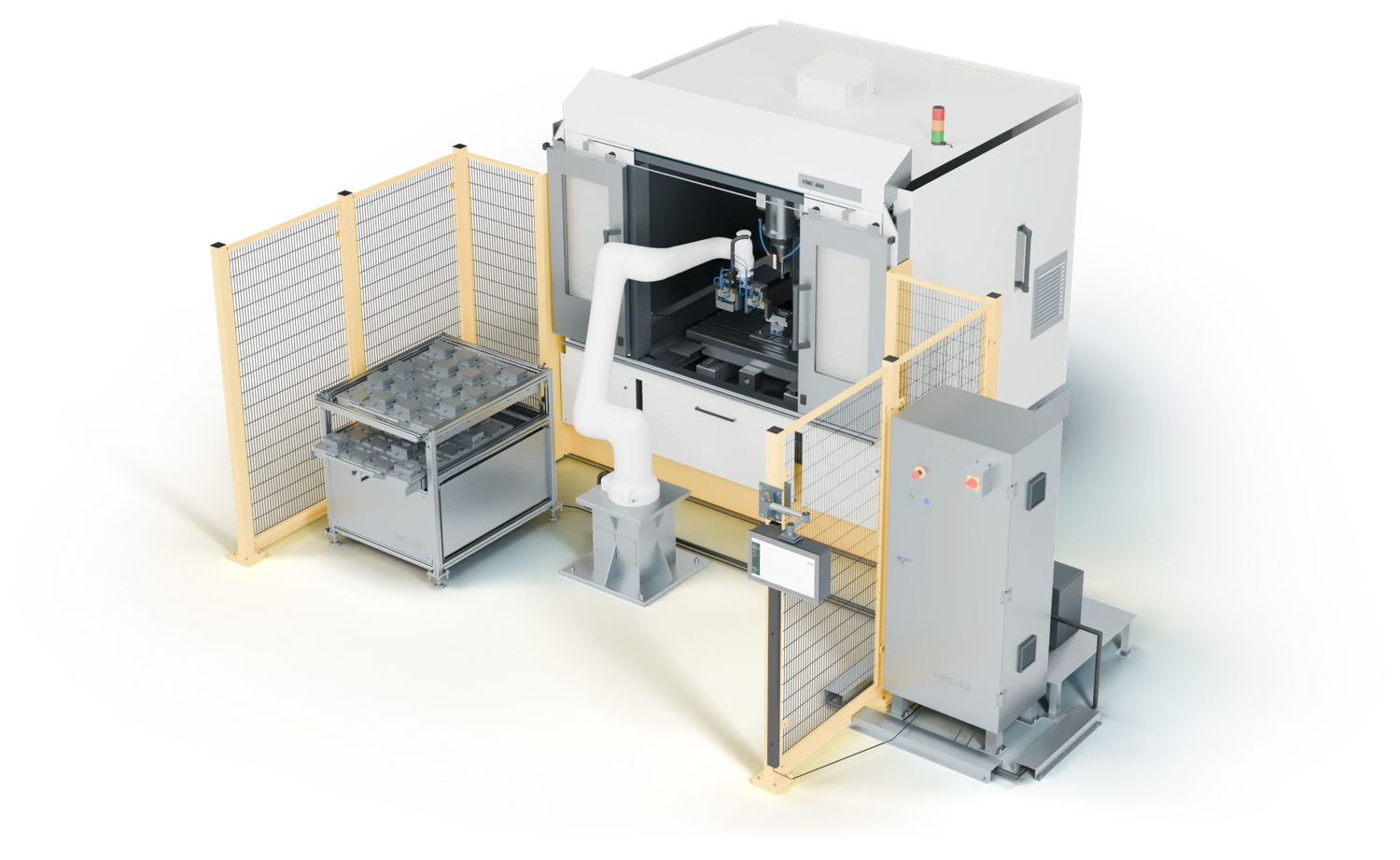
We automate loading and unloading at your machine. Grippers, part presentation and machine interfaces are matched to your workpieces, machining times and batch sizes.
TYPICAL CHALLENGES
Workpieces and machine interfaces.
The robot needs reliable access to blanks and finished parts. We assess part orientation, gripping surfaces, workholding and machine signals. Chips and coolant are considered when selecting grippers and sensors.
01
PART PRESENTATION
Workpiece presentation and orientation
Component orientation, chips and coolant determine the workpiece presentation method. Depending on the application, pallets, trays, drawers, conveyors or 3D bin picking are used.
02
MACHINE INTERFACE
Machine interface, door and workholding
Automatic enable, door drive, clamping status, program selection and completion signal are implemented as an unambiguous handshake with safe restart.
03
PROCESS TIME
Cycle-time coordination with the machine cycle
Gripping strategy, dual gripper, buffers and motion sequence are matched to machining time. Machine availability—not robot motion alone—is the decisive factor.
TECHNICAL SOLUTION CONCEPT
The machine cycle as one system.
We combine workpiece presentation, gripping technology, machine communication and outfeed into a reproducible process. Cleaning, measuring, marking or deburring can be integrated as options.
01
Validate workpiece orientation, gripping surfaces and clamping reference
02
Door, workholding and CNC signals with a validated handshake
03
Decouple raw and finished parts using dual grippers or buffers
04
Allow for chips, coolant, rejected parts and residual quantities
ENGINEERING CRITERIA
Unattended runtime, changeovers and operating conditions.
Machine tending can be suitable for recurring parts with controlled transfer to the workholding. Machine interfaces, variants and part buffers determine cost. We assess the benefit against operator time and additional usable machine running time.
01
AUTONOMY
Required unattended operating time
Batch size, buffer capacity, tool life and material replenishment determine the achievable unattended operating time.
02
ALTERNATIVES
Frequency of component and program changes
Changeable jaws, adjustable trays, recipe management and automatic program selection reduce changeover effort.
03
ENVIRONMENT
Media affecting the gripper and sensors
Oil, chips, heat and sharp-edged parts influence protection rating, gripping principle, sensor selection and cleaning requirements.
04
DOCUMENTATION
Process data to be stored
Workpiece ID, machine program, pass/fail status and measured values can be traced to the production order.
HOW WE WORK
Validate the loading sequence at the machine.
We assess the existing machine and part flow. Gripping trials and interface checks establish how loading, clamping and machining can work together. During production ramp-up, we also test interruptions and part changes.
01
Assess the machine and part flow
We assess interfaces, workholding, workpieces, machining time, available space and required autonomy directly on the existing equipment.
02
Validate the loading concept and cycle time
Gripping trials, layout, signal sequence and buffers are evaluated; critical steps are tested before detailed engineering.
03
Integrate and stabilise the production run
Assembly and programming are followed by restart, fault-scenario and variant testing under real production conditions.
Planning your application
Questions about automated machine tending.
Automatic loading needs to match the machine, the range of parts and the production workflow. These questions help define a practical scope for a machine tending system.
- Recurring parts with accessible gripping surfaces and a defined transfer to the workholding are good candidates.
- Weight, dimensions, surface and variation between blanks determine the gripper and part presentation.
- For small batches, we assess the effort involved in changeovers and replenishment.
- We check access to the workspace, the door, workholding and available control signals.
- Loading, clamping, program start and completion signals need a coordinated sequence. Missing interfaces or manual doors may require modifications.
- Reach, part and gripper weight, and cycle time determine suitable robotics. Protective measures are assessed for the complete sequence.
- Grip and clamping states are coordinated with machine permissions. Each step starts once the specified feedback signals are present.
- We define clear responses to rejected parts, residual quantities and interruptions, and test restart behaviour.
- Workpiece ID, machine program, inspection status and measured values can be recorded where required.
- Changeable jaws, adjustable trays and recipes can simplify switching between parts.
- The gripper, part orientation and clamping reference must suit every planned variant. CNC program selection is also integrated into the sequence.
- Changeover frequency and setup effort are included in the technical and economic assessment.
- Replenishing blanks, removing finished parts and changing tools remain part of production.
- Runtime without intervention depends on factors including magazine capacity, machining time and tool life.
- Chips and coolant affect cleaning and maintenance. We agree planned operator interventions with your team.
- Machine type, controller and photos of the workspace, door and workholding are useful.
- Part drawings or samples, weights, machining times and batch sizes provide an initial overview. A short video of the current loading sequence adds context.
- Send what you have available. We clarify open questions about interfaces, space and required runtime together.
SERVICE & SUPPORT
Service for machine-tending systems.
The scope of service is aligned with the installed technology, shift pattern and your maintenance organisation.
01
Mechanics and interfaces
Inspect grippers, workholding, door systems and machine interfaces.
02
Programs and cycle time
Back up PLC and robot programs, assess fault sequences and optimise motion.
03
Spare and wear parts
Coordinate planned replacement of sensors, gripper components and door drives.
DISCUSS YOUR PROJECT WITH US
Assess machine tending for your production.
Send machine type, photos of the workspace and workholding, part dimensions, batch sizes and machining time. We assess access, interfaces and the loading sequence. For automated machine loading with a workpiece magazine, see NIKLAS Machine Loader.