PROCESS AUTOMATION
Automate welding and surface processing.
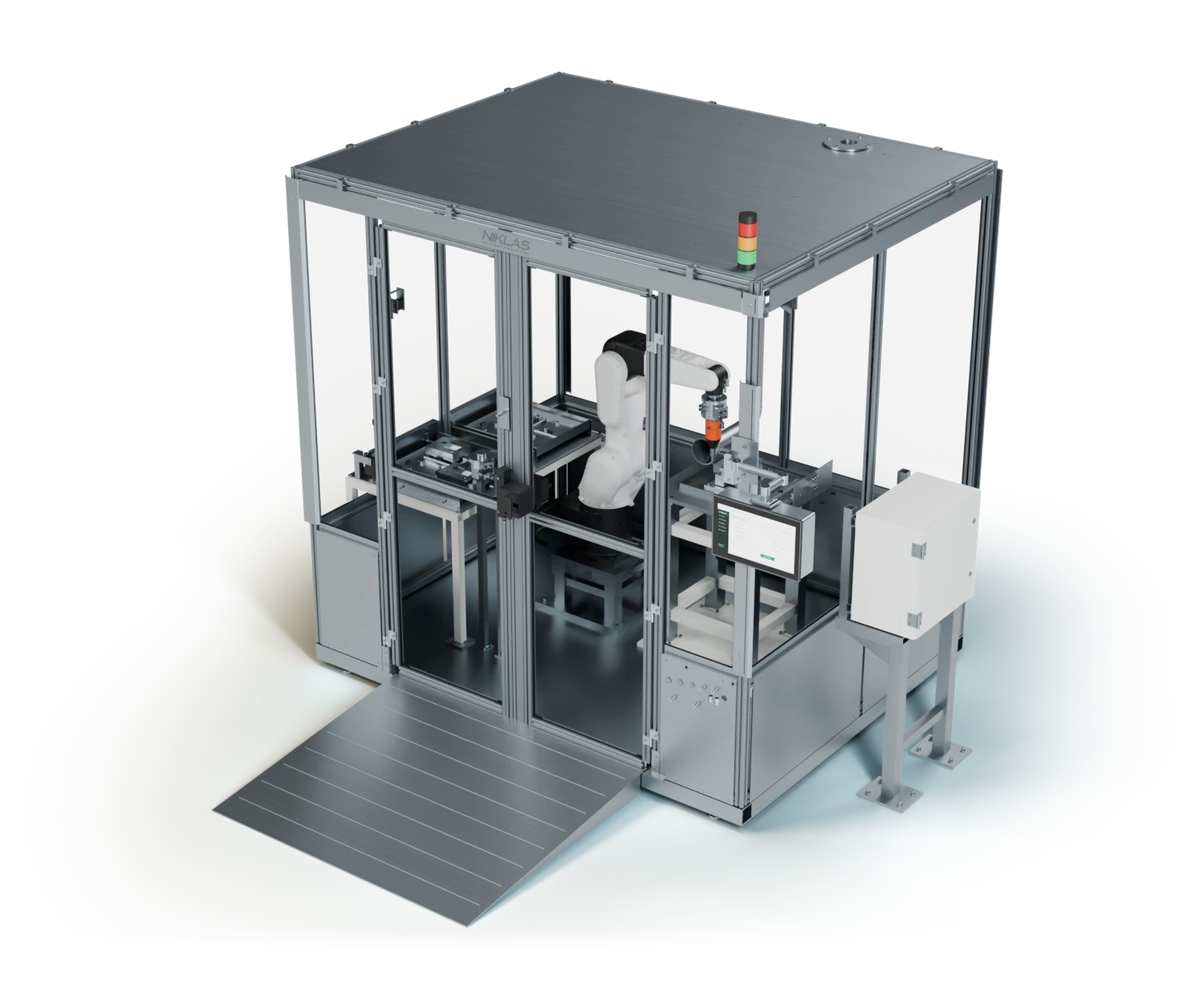
Use robots to process repeated welds, edges and surfaces. We assess tool access and part variation, then coordinate fixtures, process tools, extraction and guarding for the task.
TYPICAL CHALLENGES
Part variation and tool contact.
Welding depends on seam position, joint gap and tool access. In deburring, grinding and polishing, contact force and tool condition affect material removal. We assess these conditions using your parts.
01
COMPONENT VARIATION
Component tolerances and actual contour
Clamping, manufacturing and thermal tolerances shift the seam or surface. Touch sensing, vision or seam tracking corrects the robot path.
02
PROCESS FORCE
Force, angle and contact during processing
Grinding and polishing depend on force, angle, speed and tool wear. A purely position-controlled path can quickly produce uneven material removal.
03
PERIPHERALS
Process tooling, fixtures and utilities
The process cell includes robotics, positioners, workpiece clamping, torch cleaning, extraction and tool changes.
TECHNICAL SOLUTION CONCEPT
Path-controlled processing with sensors.
We integrate robotics, fixtures, process tooling and sensors. In welding, seam position and parameters are monitored; in surface finishing, force control and tool management ensure uniform material removal.
01
Engineer workholding, accessibility and processing sequence
02
Compensate for tolerances using touch sensing, vision, seam tracking or force control
03
Integrate the welding source, positioner, torch maintenance or grinding tool
04
Allow for extraction, guarding, tool life and quality data
ENGINEERING CRITERIA
Coordinating tools, fixtures and sensors.
Robotic welding and surface finishing require accessible welds, edges and surfaces. Part variation, workholding and tool wear constrain the process. Fixtures, sensors and protective measures determine cost; we check the required quality using sample parts.
01
GEOMETRY
Accessibility of all seams and surfaces
Robot pose, torch or tool angle, positioner and collision envelopes are simulated together.
02
TOLERANCE
Actual component-position variation
The required sensors depend on gap, seam shape, contour deviation and fixture quality.
03
PROCESS
Parameters governing process quality
Welding current, wire, speed and heat input—or force, rotational speed and grit—are managed as recipes.
04
MAINTENANCE
Wear-part replacement intervals
Torch tips, wire, abrasives and tool condition are monitored and incorporated into the system sequence.
HOW WE WORK
Welding and finishing trials with your parts.
We assess critical contours, workholding positions and tool conditions using actual parts. Simulation and trials establish accessible paths and the settings needed for the required finish or weld quality.
01
Assess components and required quality
We assess geometry, tolerances, fixtures, process parameters, required surface or weld quality and variants.
02
Trial the path, sensors and tooling
Critical contours are tested using original parts; simulation and trials validate accessibility and the process window.
03
Validate recipes and wear scenarios
During ramp-up, we test component variation, tool changes, extraction, restart and documented quality characteristics.
Planning your application
Questions about robotic welding and surface finishing.
Welds, edges and surfaces place different demands on a cell. These answers help match the process tool, workholding and path control to the required result.
- Repeated welds, edges and surfaces are suitable when tools can reach the processing locations and quality requirements are defined.
- For welding, we assess material, joint geometry and workholding. For deburring, grinding and polishing, we assess burr variation, target finish and permissible material removal.
- Actual parts and processing trials establish which tasks can be handled with the intended tools and fixtures.
- Fixtures must hold the workpiece while leaving processing locations accessible. Positioners can provide additional tool angles.
- Varying seam positions may require touch sensing or seam tracking. Controlled contact force may compensate for position variation during grinding and polishing.
- The welding source, tools, extraction and protective measures are coordinated with robotics and workholding.
- Weld geometry and quality requirements are defined for welding. Surface finishing is assessed against the target finish and permissible material removal.
- We trial critical contours and actual part variation, including tool wear and required operator interventions.
- Process settings, inspection characteristics and recorded results are agreed for the specific task.
- Programs, fixtures and process settings are designed for the intended variants.
- Changes in seam position, burrs or surfaces may require different tools, sensors or fixtures.
- Variants are assessed using representative parts. The validated process window defines the variation the cell can handle.
- Loading, changeovers and checking tools and wear parts remain part of operating the system.
- Torch tips, wire, abrasives and process media need replacement or replenishment according to use.
- Maintenance of fixtures, extraction and protective systems, plus program backups, is included in operating requirements.
- Photos, drawings or CAD data show processing locations. Sample parts help assess access and part variation.
- Useful details include material, required weld or surface quality, variants, production quantities and existing tools and fixtures.
- Send the information you already have. We will work through any open questions with you.
SERVICE & SUPPORT
Service for welding and finishing systems.
The scope of service is aligned with the installed technology, shift pattern and your maintenance organisation.
01
Process tooling and protective systems
Inspect tools, extraction, workholding and protective systems.
02
Paths and parameters
Optimise robot paths, process parameters and programs.
03
Restart and wear
Maintain program versions, wear parts and a repeatable restart procedure.
DISCUSS YOUR PROJECT WITH US
Assess welding and surface finishing for your production.
Send drawings or samples, material, tolerances and the required quality criteria. Photos or a process video help assess tool access, workholding and trials. For a modular robotic deburring cell, explore NIKLAS Surface Cell.